
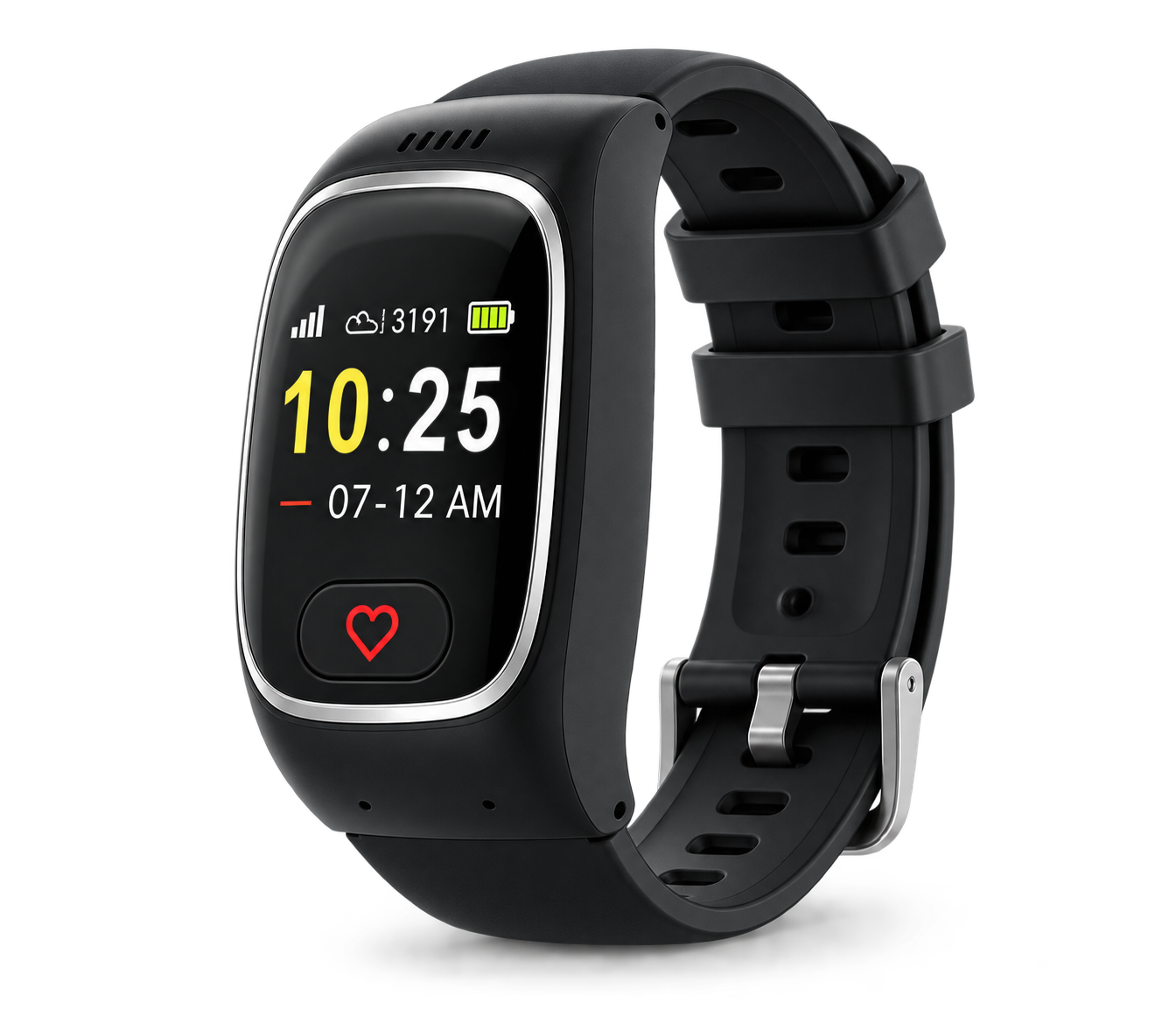
Go — adults GPS watch
Best suited to: everyday watch wearers, and anyone who wants wellbeing tracking too.
- SOS, two-way speech and GPS on the wrist
- Automatic fall detection included
- Health and wellbeing tracking
- IP67 water resistant
If the person has worn a watch most of their life, the Go watch usually wins — it slots into an existing habit, stays on the wrist and is hard to leave on a side table. If they have never liked anything on their wrist, or if the priority is one large button and nothing else to think about, the One pendant is the better fit.
What does not change between them is the service. Both devices call the same UK monitoring centre, both open hands-free speech, both send GPS location with the alert and both include automatic fall detection. Neither needs a landline or home broadband.
So this is a comfort-and-habit decision rather than a protection decision — which is genuinely good news, because it means you can choose on what the wearer likes rather than on what they might be giving up.
Everything below reflects what these two devices actually do.
How it is worn
SOS button
24/7 UK monitoring
Two-way speech
GPS location with alerts
Automatic fall detection
4G SIM included
Water resistance
Health and wellbeing tracking
Shows the time
Family app access
Charging
Monitoring plan price
(Pendants may vary.) Fall detection is included on both devices, but no fall-detection system can identify every fall.
Putting it on in the morning is an existing habit, so there is nothing new to remember and no new object to accept.
The Go watch offers wellbeing tracking alongside its safety features, which some people value as much as the SOS button.
A wrist device is unlikely to be left behind on the way out of the door, which is exactly when GPS matters most.
For some people the wrist is simply the easiest place to reach reliably, including from the floor.
Plenty of people have never worn a watch and never will. A pendant under or over clothing avoids that objection entirely.
No screen, no time display, nothing else to interpret — just an unmistakable button that does one thing.
A larger button worn on the chest can be easier to locate and press than anything on a wrist strap.
On a neck cord for most of the day, or in a pocket when that is more comfortable — the speech and SOS work either way.
Same monitoring, same core safety features, two different formats.
Best suited to: everyday watch wearers, and anyone who wants wellbeing tracking too.

(Pendants may vary)
Best suited to: people who prefer one simple button and nothing on the wrist.
The monitoring is the same service on both devices: trained UK operators, 24 hours a day, 365 days a year, answering with the wearer's file and the device's location on screen and working through the nominated contacts and instructions agreed in advance.
The connection is the same too. Each device carries its own 4G SIM, included in the plan, so protection is not limited to the inside of the house and there is nothing to plug in or top up.
Plan pricing is the same for both adult devices, and the equipment in each case is supplied for use with the monitoring service and remains the property of Medi Alarm 247 Limited, to be returned when the service ends in line with our terms and conditions.
See the plans on personal alarm costs, or read monitored vs unmonitored alarms if you are still deciding what kind of alarm you need.
A five-minute conversation about what they would actually wear prevents most returns. Include them in the decision wherever you can.
Whichever format you choose, the device needs a routine top-up. Nominated contacts can check the battery in the TrueKare app.
Both devices need usable mobile signal. If a particular home or area concerns you, ask our team before ordering.
Neither is better in general — they differ in how they are worn rather than in the protection they provide. Both the Go watch and the One pendant have a monitored SOS button, two-way speech, GPS location and automatic fall detection. The right choice is the format the wearer will keep on every day.
Yes, automatic fall detection is included as standard on both. No fall-detection system can identify every fall, on any device, so the SOS button remains the most reliable way to raise help when the wearer is able to press it.
Yes. Each device has its own 4G SIM and GPS built in, so both work at home and away from it wherever there is usable mobile coverage. Neither depends on a base unit, a landline or home Wi-Fi.
Many people find the pendant simplest, because it is one large button and nothing else. That said, someone who has worn a watch every day for decades often finds the watch easier still, because it fits a habit they already have. Existing routine usually matters more than the number of buttons.
Both devices are IP67 water resistant, designed for everyday rain, splashes and temporary water exposure — worth knowing, as bathrooms are where people most often worry about a fall. Neither is completely waterproof, so we recommend minimising unnecessary water exposure and avoiding swimming, bathing and prolonged submersion.
The Go watch also offers health and wellbeing tracking alongside its safety features, and it shows the time, which some people prefer. The pendant concentrates on being a single, unmistakable SOS button.
There is a 30-day money-back guarantee, so if the format turns out not to suit the wearer you are not stuck with it. Our team are also happy to talk it through beforehand — that conversation prevents most mismatches.
Tell our UK team a little about the person who will wear it and we will give you an honest recommendation — and there is a 30-day money-back guarantee either way.
Phone lines open Mon–Fri, 9am–5pm. Go and One: 24/7 monitoring, 365 days a year. Junior: family monitored via the app only.