Go & One: 24/7 UK Monitoring No Long Contracts Free Delivery 30 Day Money Back Guarantee
Location technology, used respectfully

GPS Trackers & Personal Alarms for Dementia

Families supporting someone with dementia or memory difficulties often want the same two things: a way for that person to call for help, and a way to know where they are if something goes wrong. Our GPS safety devices combine one-button SOS calling to our 24/7 UK monitoring centre with location information for nominated family members.
SOS calling to a UK operator, 24/7
GPS location shared with every alert
Nominated family can check location in the app
Works at home and away — no landline needed
TrueKare app map view showing the location of a MediAlarm GPS safety device

What a GPS safety device actually is

A GPS safety device is a wearable — in our case a watch or a pendant — that contains an SOS button, a speaker and microphone, a GPS receiver and its own 4G SIM. It is not a medical device and it does not monitor a condition. It is a way of asking for help and of sharing a location when help is needed.

When the SOS button is pressed, or when fall detection triggers, the device calls our monitoring centre over the mobile network and opens hands-free speech. An operator answers with the wearer's file and the device's location on screen, and works through the contacts and instructions the family has agreed with us in advance.

Between alerts, nominated family members can check the device's location, battery level and alert history in the TrueKare app. For many families that is the part that reduces day-to-day anxiety most — not because they watch it constantly, but because the information is there if a phone call goes unanswered.

An honest boundary: a GPS device does not treat dementia, does not prevent anyone from walking out of the house, and cannot guarantee anybody's safety or an exact location. It is one practical tool that sits alongside the support, routines and care arrangements already in place — not a substitute for any of them.

How the technology can help

Genuine features of the Go watch and the One pendant.

One button, one action

There is no phone to find, no screen to navigate and no number to remember — press and hold the SOS button and the call is placed for you.

Two-way voice

The wearer speaks to a trained UK operator through the device itself, hands-free. A familiar, calm voice at the other end matters a great deal in a moment of confusion.

Location with the alert

Our operators see where the device is when an alert arrives, which helps direct a relative or the emergency services. More on how we locate you.

Family app access

Nominated contacts can check location, battery and alert history in the TrueKare app, set up openly with the wearer's knowledge.

4G, not Wi-Fi

The SIM is included, so the device works away from the house and does not depend on home broadband or a phone line.

Fall detection

Included as standard on both devices, for the times the button cannot be pressed — though no system detects every fall. See fall alarms.

Where location technology has limits

Being clear about this is more useful than a reassuring sales claim.

Location comes from a combination of GPS satellites and the mobile network. Both can be degraded: tall buildings, dense woodland, underground spaces and the middle of large buildings all reduce accuracy, and in some remote areas mobile coverage may be too weak for the device to report at all.

In practice this usually means the location is close enough to guide someone to the right street or the right area rather than the exact step. That is genuinely valuable in an urgent situation, but it is not the same as a guaranteed pinpoint, and any provider who promises one is overstating what the technology does.

The device also has to be worn and charged to be useful. A wearable in a drawer reports nothing, which is why choosing a format the person will actually accept matters more than any specification on this page.

Watch or pendant?

Both devices offer SOS, two-way speech, GPS and fall detection. The right one is the one that gets worn.

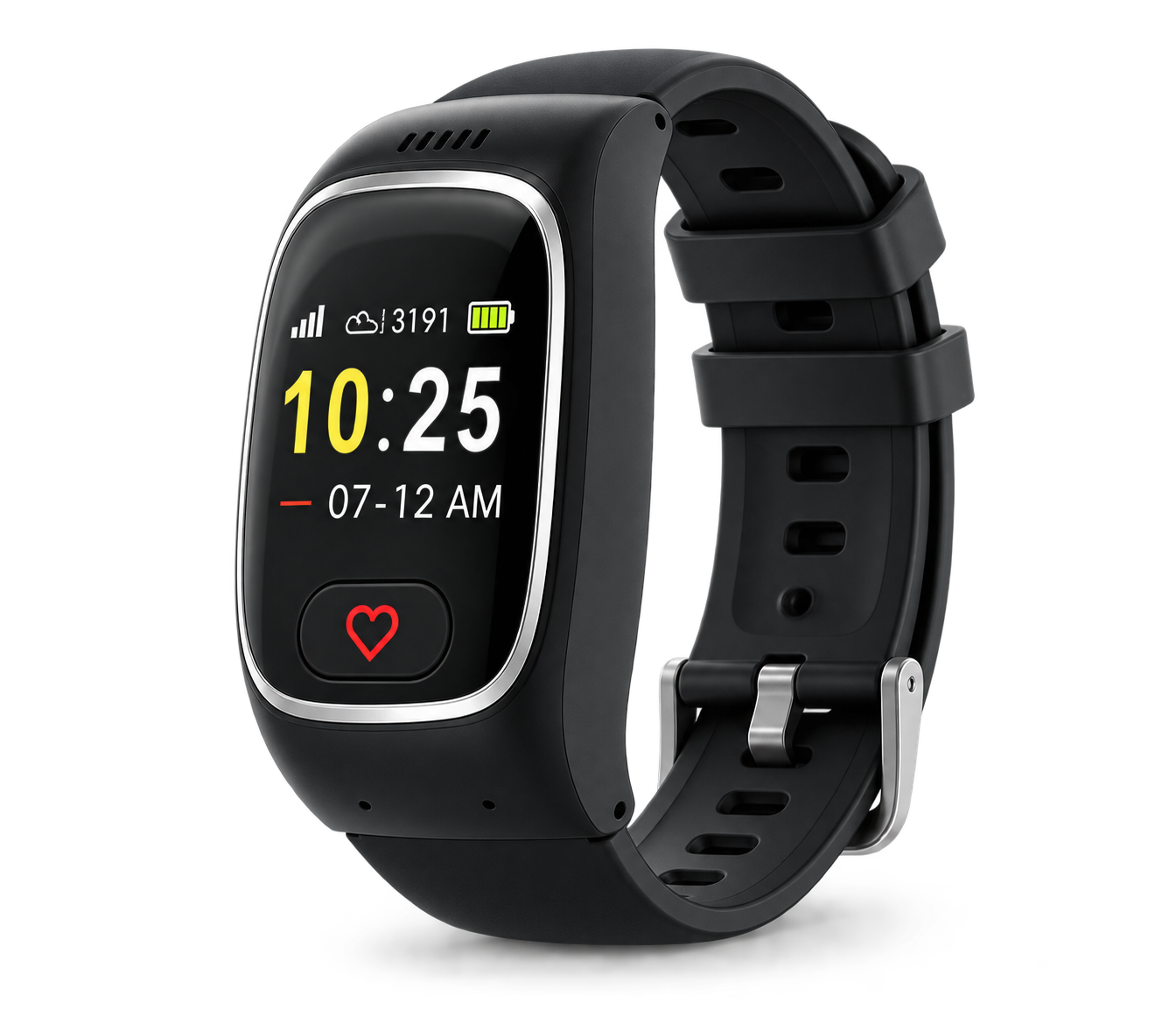
Go GPS safety watch with SOS button and location tracking

Go — adults GPS watch

Best suited to: someone who has always worn a watch and will accept a familiar object on the wrist.

  • Looks and feels like an everyday watch
  • Harder to take off and leave behind than a pendant
  • SOS, GPS and fall detection on the wrist
  • IP67 water resistant
View the Go watch
One GPS safety pendant with a single large SOS button

(Pendants may vary)

One — GPS pendant

Best suited to: someone who dislikes anything on the wrist, or who is better served by a single obvious button.

  • One large button and nothing else to learn
  • Worn on a neck cord or carried in a pocket
  • GPS and fall detection included
  • Two-way speech through the pendant
View the One pendant

Dignity, privacy and involving the person

Ask, do not impose

Where the person is able to take part in the decision, involving them tends to produce a device that is worn and accepted. A safety device introduced as support usually lands very differently from one introduced as monitoring.

Open, not covert

We ask that app access is set up with the wearer's knowledge. Location information exists so that help can reach someone, not so that their movements can be reviewed without their awareness.

Familiar objects work best

A watch that resembles a watch, worn at the times a watch is normally worn, asks very little of anyone's memory. Fitting the device into an existing habit beats introducing a new one.

Charging needs a routine

Attach charging to something that already happens regularly. Nominated contacts can check the battery level in the app and prompt a top-up if it has been missed.

What happens when an alert reaches us

Our monitoring centre is staffed 24 hours a day, 365 days a year by trained UK operators. When a call arrives they already hold the details the family has given us: the wearer's name and address, any health or communication notes, nominated contacts in order, and key-holder access details.

The operator speaks to the wearer first and takes the situation from there — a reassurance call and a follow-up, a nominated contact asked to attend, or the emergency services contacted with the location and notes passed across. If nobody responds on the device, silence is treated as a reason to escalate rather than to end the call.

We are a monitoring service rather than an emergency service: our operators request assistance on the wearer's behalf, but the attendance and priority of ambulance or police services is always determined by those services.

Step by step: how our monitoring works. If the person lives on their own, see personal alarms for people living alone.

Frequently asked questions

Can GPS help locate someone living with dementia?+

It can help, and that is the right way to think about it. When an alert is raised, our operators see the device's location alongside the wearer's file, and nominated family members can check the device's location in the TrueKare app. Location technology gives people a much better starting point than no information at all — it does not guarantee that someone will be found, and it does not replace a plan agreed with family and the people involved in their care.

How accurate is a dementia GPS tracker?+

Usually accurate enough to point help in the right direction, but accuracy varies. It depends on satellite visibility, mobile network coverage, dense buildings, tree cover and whether the wearer is deep inside a building. Nobody can honestly promise pinpoint accuracy from a wearable device, which is why our operators combine the location with speaking to the wearer wherever they can.

Does the tracker work outside the home?+

Yes. The Go watch and the One pendant each contain their own 4G SIM and GPS, so they work at home, in the garden and away from the house wherever there is usable mobile coverage. There is no base unit and no range limit around the property.

Does it need Wi-Fi or a landline?+

No. The SIM is included in the plan, so there is no broadband, Wi-Fi or phone line requirement and nothing to top up.

Can family members access location information?+

Yes. Nominated contacts can use the TrueKare app to see the device's location, its battery level and its alert history. We ask that this is set up openly, with the wearer's knowledge, rather than covertly.

What if the person will not wear the device?+

This is the single most common practical obstacle, and it is worth solving before ordering. Some people accept a watch readily because it looks like a watch and fits an existing habit; others get on better with a pendant or a device kept in a pocket. Our team are happy to talk through what tends to work, and there is a 30-day money-back guarantee if the format turns out to be wrong.

How often does it need charging?+

Both devices need regular charging (the Go watch lasts approximately 3–5 days, depending on usage and settings). Building charging into an existing routine is usually what makes it stick, and nominated contacts can check the battery level in the TrueKare app.

Talk it through before you decide

Our UK team can talk honestly about what location technology does and does not do, and which device tends to be accepted and worn. There is no obligation to order.

Phone lines open Mon–Fri, 9am–5pm. Go and One: 24/7 monitoring, 365 days a year. Junior: family monitored via the app only.